I work with various business owners, but two categories stand out lately.
- The salon that's been cutting and coloring tresses for years, or the small cafe where regulars walk in, nod and get their coffee.
- Someone with twenty years of solid experience, leadership and proof points who is suddenly a fractional CMO, solo consultant, startup founder or one-person firm figuring it out in real time.
Neither category wins unless people, especially machines, can find them. And I don't mean just finding them in person. I'm talking online.
This is why I am spending so much time on it.
Layoffs aren't a moment. They're the climate now.
Layoffs stopped being an event and quietly became a condition. Kind of like watching a movie and wondering when the next jump scare is going to happen.
U.S. employers announced just over 1.2 million job cuts in 2025, up 58% from the year before, the seventh-highest annual total since 1989, while hiring plans fell to their lowest level since 2010, according to Challenger, Gray & Christmas. It lands hardest on people in the middle of their careers: when workers between 50 and 65 lose a job, nearly a quarter still haven't found steady work. Gen X in particular, carrying the highest average debt of any generation while raising kids and caring for aging parents, tends to absorb this at the worst possible time.
Hello Sandwich Generation friends.
A lot of those people don't go back to a cubicle. They become the business.
The quiet next small business is one person
When we say "small business," we picture storefronts. But the fastest-growing kind of small business right now has no storefront and often no employees. It's one person, and their own name is the whole company.
The numbers back this up. Americans filed a record 5.5 million applications to start new businesses in 2023, and the pace has held roughly 50% above pre-pandemic levels, per the Census Bureau. More than 72 million Americans now work independently, by MBO Partners' count, and a record 5.6 million of them earn six figures. Fractional work is a genuine career for many.
These aren't hobbies. A fractional CFO serving three companies is a small business. A solo consultant is a small business. They just haven't started calling themselves one yet. And most of them have never had to make the internet notice them before. That was always someone else's job, a marketing team or an agency or a brand with a budget. Now it's theirs, and it's the one skill their old career never taught them.
Being good at the work and being found are two different jobs
You can be the best fractional CFO in your city and be completely invisible to the tool your next client is asking right now. The cafe can have the warmest room in town and say almost nothing to the machine that answers "coffee near me." Being good at the work and being found are two different jobs. Most people, established or brand-new, only ever do the first one.
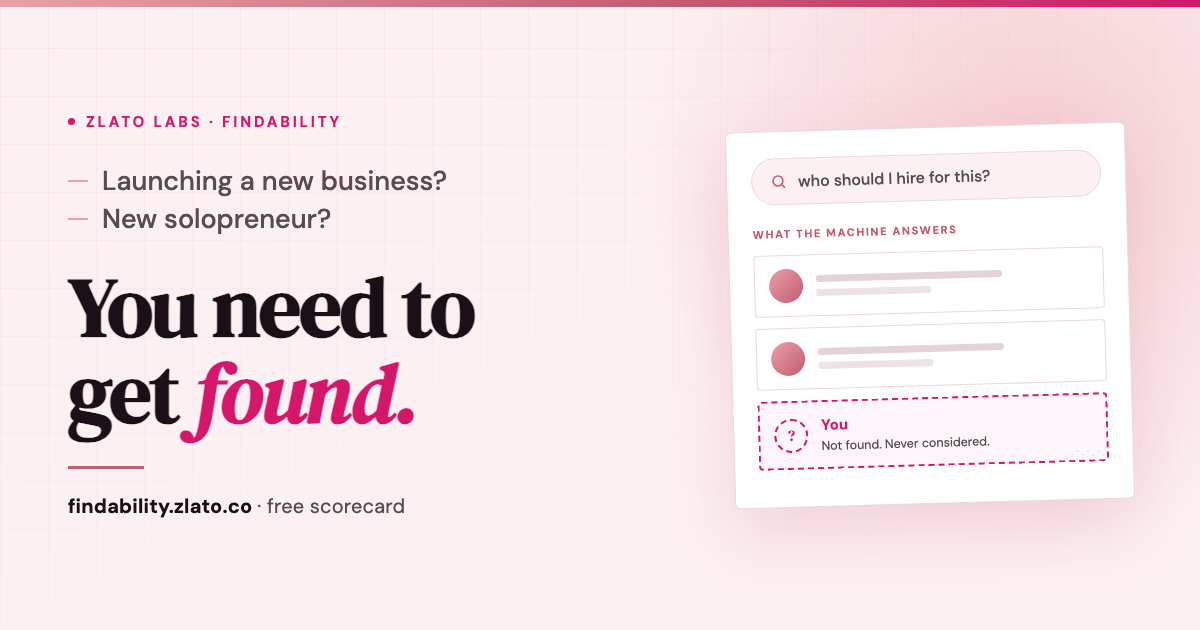
The machines that now answer "who should I hire for this?" don't file a complaint when they can't read you. They just move on to the business they could read. You never find out.
There's no bounce rate for a recommendation you were never considered for. Let that sink in.
Let's talk VC
Only about 4% of all venture capital goes to Black and Latino founders combined, people who make up roughly a third of the country. Women don't fare much better: startups founded entirely by women took in just over 2% of all VC dollars in 2024, even though women-founded companies made up more than 6% of the deals. The combined share going to Black and Latina women founders has only once, briefly, crept above 1%. Funding to Black founders specifically fell to 0.4% of all startup dollars in 2024, the lowest in years. And the founders who do get the check often share the same few things: the right school, the right former employer, the right room they happened to be standing in.
I can't fix venture capital. But I can tell you what that math means for the rest of us: if the money isn't coming, the leverage has to come from somewhere else. The cheapest, most democratic leverage available is understanding how the web actually works. How to be found, how to be understood, how to build awareness without a war chest. Those building blocks don't check your pedigree. They just work, if you set them up right. That's not a consolation prize. It's the actual game.
Small business isn't the little version of the economy. It is the economy.
We treat "small business" like a category off to the side. It isn't. There are 36 million small businesses in America, 99.9% of all U.S. businesses. They employ 62 million people, almost half the private workforce, and over the last year they created about nine of every ten net new jobs, according to the SBA's Office of Advocacy. Now add the wave of solo operators and fractional consultants forming on top of that, and you're looking at the real engine of the whole thing.
None of them have a corporate marketing department behind them.
That's what I've decided to do with more than two decades of corporate marketing experience: point all of it here. Not at the next enterprise logo. At the small business community and the people about to join it, so they're at least set up to succeed.
What you can and should do
If you've got a little runway right now, severance, savings, or just a quieter stretch than usual, use it. Not only to rest and job-hunt, but to get your own house in order. The window when you have some room is exactly when you should be building the foundation of whatever comes next, because you may never have this much uninterrupted time again.
And the foundation isn't a logo or a color palette. It's this: people won't know what you do unless you have a presence, and that presence has to be findable by both humans and the machines that now make the first introduction. Whether you're a business that's run for fifteen years or one you launch next Tuesday, that requirement is identical.
Whether it was casual run ins at my local Trader Joe's or working with a local salon, I kept doing the same work around findability and decided to build a tool.
The free Findability scorecard
Put in your site, or the site you're about to launch, and it reads you the way Google, ChatGPT and Perplexity actually do, then tells you, honestly, what they can and can't see. It takes about a minute. If your score surprises you, that's what the deeper Report is for. When it's time to actually build the awareness and you need an extra set of hands, let's chat.
Get your score ↗No one's coming to save us. I really believe that. But the list of things within your control is longer than it feels. It all starts with being findable. The best time to set that up was before you needed it. The second best time is right now.
Blagica, Zlato Labs