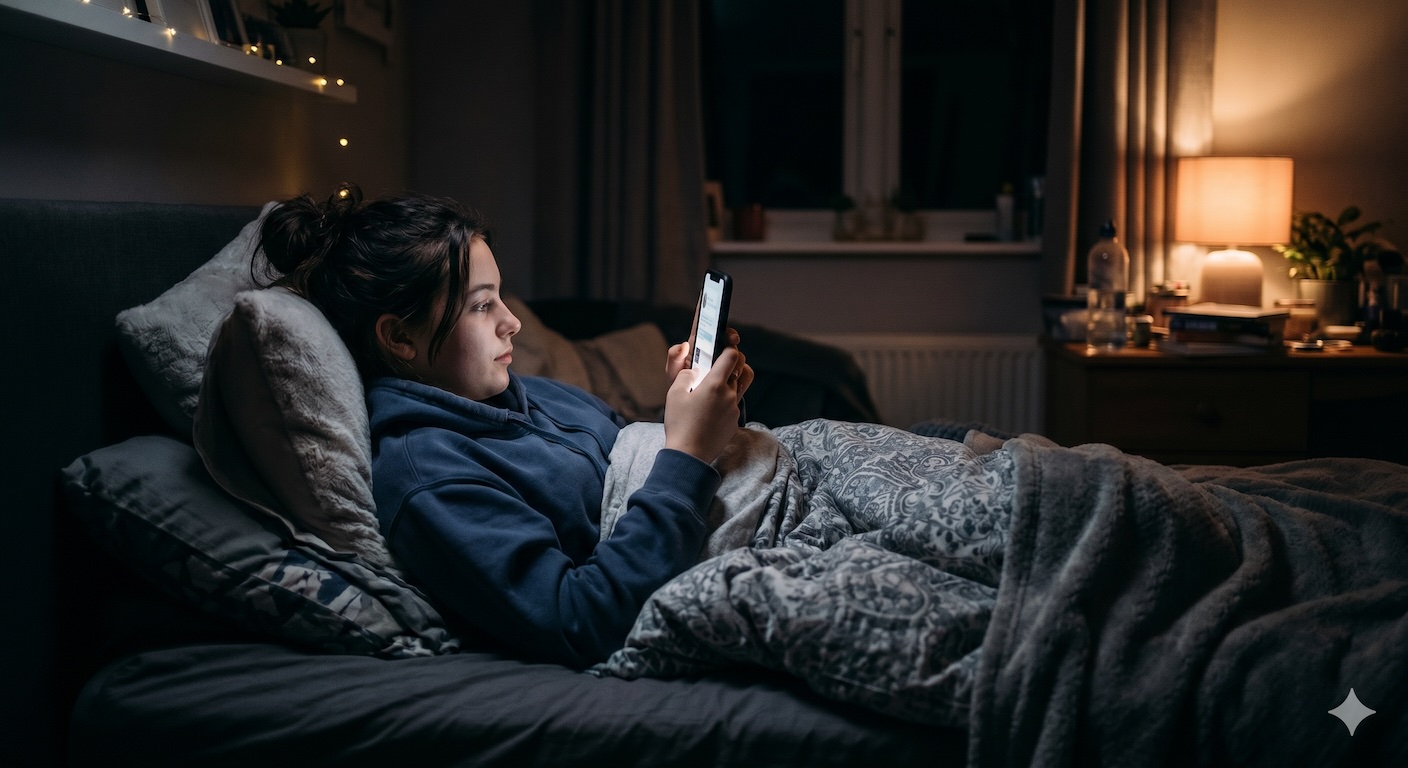
I was listening to Tristan Harris on On with Kara Swisher the other day. He was talking about how, in the United States, we have effectively let an entire generation of children become the live test subjects for the most addictive products ever invented. Then he made a quiet, almost comparison that made me pause and then rewind: in China, kids don't get unlimited access. I have spent my entire adult career inside the machine that engineered this attention crisis. And when the country we love to position as our biggest competitor is putting actual, enforceable guardrails around the digital lives of its children, and we are not, we should at least be willing to ask why.
What China Is Actually Doing
Most Americans have a vague sense that "China restricts screens for kids," but the specifics are striking. This isn't a parental-controls suggestion buried in a settings menu. It's national policy, enforced at the platform level, with real-name verification.
Gaming
Since 2021, minors in China have been limited to three hours of online gaming per week — one hour on Friday, Saturday, Sunday, and public holidays, between 8 and 9 p.m. That's it. Game companies are required to enforce it through real-name registration, and the government once described gaming addiction as "spiritual opium."
That rule is still on the books in 2026, and China has only added more guardrails since — including a 15-hour-per-month cap during school breaks introduced in 2024. Enforcement isn't airtight (a 2024 report found roughly a quarter of Chinese minors still find ways around the limits, usually by borrowing a parent's ID), but the direction of travel is unmistakable: more guardrails, not fewer. This isn't a one-off political moment. It's a sustained national posture.
Short-Form Video
Douyin, the Chinese version of TikTok, caps users under 14 at 40 minutes a day, only between 6 a.m. and 10 p.m. The same company — ByteDance — ships an algorithmically different product to American kids with no such limits. Their teen mode in China surfaces science experiments, history, art, and museum tours. Ours surfaces whatever keeps a thumb scrolling. That's not a cultural difference. That's a product decision.
The Internet Itself
China has been rolling out a "minor mode" framework that asks device makers to bake limits into the phone itself: a curfew between 10 p.m. and 6 a.m. for anyone under 18, plus daily caps tied to age — two hours for 16- to 18-year-olds, one hour for 8- to 16-year-olds, and just 8 minutes a day for kids under 8. Whether you find that draconian or sensible, it is at least a coherent answer to the question "how much is too much?" — a question we, in the U.S., refuse to even ask out loud.
AI Companions and Chatbots
This is the part that should get every parent's attention. In late 2025 and into 2026, China's Cyberspace Administration drafted rules specifically targeting AI companions and emotionally interactive chatbots. The proposed rules would require platforms to obtain explicit guardian consent before letting minors use these services, automatically switch identified minors into a stricter "minor mode," and ban virtual romantic partners, virtual relatives, or any emotionally intimate AI relationship for anyone under 18. If a user expresses suicidal intent, a human must take over the conversation and contact the guardian.
Read that again. While American teenagers are forming attachments to AI girlfriends and confessing their darkest thoughts to chatbots that have no clinical training and no obligation to anyone, China is drafting rules that say: no, you cannot sell an emotionally manipulative AI relationship to a child.
On top of that, a new content classification system took effect March 1, 2026, requiring platforms to categorize content that may harm the physical or mental health of minors — not just illegal content, but content that promotes unhealthy habits, distorted values, or unsafe imitation. The burden falls on the platforms, not on parents.
The Tristan Harris Point — and Why It Matters for Parents
Harris's argument, on Kara's show and on Pivot with Scott Galloway, is that children are the front line of the AI crisis. Not in some abstract "future of work" way — right now. AI companions are scaling. Teen mental health is collapsing on a measurable curve. And the same incentive structure that gave us infinite-scroll feeds is now being pointed at general-purpose intelligence. He calls for age-gating, liability laws, and — importantly — a global reset before "intelligence becomes the most concentrated form of power in history."
You don't have to agree with every word of his framing to notice the asymmetry. The U.S. is racing to deploy. China is racing to deploy and to regulate the deployment to its own kids. Whatever you think about Beijing's motives — and we should be honest about them — the practical effect is that a 13-year-old in Shanghai is being shaped by a very different digital diet than a 13-year-old in Sheboygan.
Let Me Say the Obvious Thing About China
China's motivations are not pure. The same government that limits Douyin to 40 minutes a day for kids also runs one of the most sophisticated surveillance and censorship regimes on earth. "Minor mode" is not just about wellbeing; it's about shaping what young citizens see, value, and aspire to. The state benefits when kids spend less time on entertainment and more time on STEM. Some of these rules also serve a nationalist agenda — promoting traditional culture, deemphasizing Western influence, and producing the kind of focused, technically capable workforce that wins the next two decades.
I am not suggesting that we should hand the keys of American childhood to a centralized authority.
But there is a difference between copying a regime and learning from a result. And the result is this: their kids will sleep more, scroll less, game less, and — increasingly — grow up alongside AI tools that have been deliberately defanged for childhood. Ours will not. And in 10 years, when both groups are 23 and competing for the same global jobs, on the same global platforms, in the same global economy, that head start is going to matter.
The Competitiveness Argument We're Not Having
I want to be clear about why this lands so hard for me as a builder and a marketer. We talk constantly about American competitiveness in AI. Every white paper, every think tank panel, every CEO testimony in front of Congress is some version of "we must out-innovate China."
Fine. But you cannot out-innovate anyone with a generation that can't focus.
There is no version of American leadership in the next industrial era that runs on kids who lose three hours a night to algorithmic feeds, who outsource their first emotional intimacy to a chatbot, who have never sat with a single boring moment long enough to have a single original thought. The competitiveness conversation and the parenting conversation are the same conversation. We just keep refusing to admit it.
Meanwhile, China is not only restricting screens — they are aggressively integrating AI into their school curriculum, training kids to use it as a tool while limiting it as a toy. That is the move. Use the technology. Don't be used by it.
What This Means for Us — Parents, Builders, and Brands
I don't have a tidy policy proposal. I'm a founder, not a senator. I'm a mom.
But I do have some honest reflections from where I sit — someone who has built inside this industry for a quarter century and who is now watching her own community of parents quietly panic.
First, we have to stop pretending that "screen time is a personal family choice" is a sufficient answer. It is not a personal choice when the product is engineered by thousands of PhDs to defeat your child's self-regulation. We don't hand kids cigarettes and call it a personal choice. We don't hand them whiskey and call it a personal choice. The asymmetry of power between a 13-year-old's prefrontal cortex and a recommender system trained on a billion users is not a fair fight, and it is dishonest to keep framing it as one.
Second, we should be loud about the difference between AI as a tool and AI as a companion. I build with these tools daily. They are extraordinary. A teenager learning to use Claude or ChatGPT to research, to code, to debate, to write better — that's rocket fuel. A teenager forming a parasocial attachment to an AI girlfriend that exists to maximize engagement metrics is not the same product, even though it shares an underlying model. China is drawing that line in regulation. We can draw it in our homes, our schools, and our products.
Third, for fellow builders and brands: this is going to become a brand-trust issue faster than the industry expects. The parents in my circle — educated, professional, often working in tech themselves — are quietly furious. They are looking for AI products and platforms that are honest about who they are designed for and what they are designed to do. "Safe by design" is going to be a competitive advantage in the next 24 months, not a compliance checkbox. The companies that figure this out first will earn a generation of parental loyalty that no growth-hacking budget can buy.
What I'm Doing in My Own House
Some of this I am still figuring out. But the practical version, for now:
Phones are out of bedrooms at night. Non-negotiable, modeled by the adults in the house first.
AI is a tool we use together, out loud, with the screen visible. We talk about what it gets wrong as much as what it gets right.
No AI companions, no "friend" apps, no character chatbots designed for emotional intimacy. Those are not toys.
Boredom is allowed. Encouraged, even. The original creativity engine still works. And yes. We fight about this everyday.
We talk openly about the business model. Kids who understand they are the product behave differently than kids who think the app loves them.
The Bigger Question
The most uncomfortable thing about looking at China's approach is not the policy itself. It is the fact that a system we don't want to emulate is, in this one narrow domain, taking the wellbeing of its children more seriously than we are. That should not sit well with anyone, on either side of the political aisle, in any sector of this industry.
We have the freedom, the talent, the capital, and — if Tristan Harris is right — a closing window to prove that a free society can also be a wise one. That we can build the future without sacrificing the people who are supposed to inherit it.
I'm betting we can. But not if we keep pretending our kids are fine.
— Blagica
Founder, Zlato